Many Owners’ Corporations, upon receiving a mandatory window inspection notice from the Buildings Department, initially react with: “Windows in common areas are the responsibility of the Owners’ Corporation, while windows in private units are handled by individual owners. Just separate them clearly.” In actual practice, this view is only half correct. The legal responsibilities, inspection scope, cost allocation, and subsequent repair authorization procedures for window inspection in common areas are far more complex than those for private units. If not handled properly, OC committee members may face personal liability, and repair costs could be unfairly borne by a minority of owners. This article provides a detailed clarification of the core differences for Owners’ Corporations managing private residential buildings in Hong Kong.
Table of Contents
- Key Takeaways
- Legal Framework of Mandatory Window Inspection: Deed of Mutual Covenant, Buildings Ordinance, and Buildings Department Guidelines
- Differences in Window Inspection Scope Between Common Areas and Private Units
- Legal Responsibilities of Owners’ Corporations in Common Area Window Inspection
- How Window Inspection Costs Are Reasonably Allocated Among Owners
- Comparison of Window Inspection in Common Areas versus Private Units
- Practical Steps for Owners’ Corporations Handling Common Area Window Inspection
- The Four Most Common Window Inspection Mistakes Made by Owners’ Corporations
- Frequently Asked Questions
Key Takeaways
| Key Points | Explanation |
|---|---|
| Common area windows are managed collectively by the OC | Under the Buildings Ordinance (Cap. 123), the responsibility for inspection and repair of windows in common areas of buildings rests with the Owners’ Corporation and cannot be shifted to individual owners. |
| Private unit windows are the responsibility of individual owners | Each unit owner must arrange and bear the costs of window inspection and repair within their own unit. |
| Window inspection must be conducted by Buildings Department approved persons | Whether in common areas or private units, window inspection work must be carried out by persons on the Buildings Department’s register of Authorized Persons or Registered Inspectors. Reports from unlicensed persons will not be accepted. |
| The OC can coordinate building-wide inspection to reduce costs | The OC has the right to coordinate window inspection for private units on behalf of owners. Collective tendering often results in more reasonable service fees, but prior owner authorization is required. |
| Common area repair costs are shared according to undivided shares | Repair costs for common areas are generally apportioned according to the undivided shares (Undivided Shares) specified in the Deed of Mutual Covenant. The OC cannot unilaterally alter this ratio. |
| Inspection reports must be submitted within the specified deadline | After receiving the notice from the Buildings Department, owners or the OC must complete the inspection and submit the computerized report within the prescribed time limit. Late submission may result in prosecution. |
| Certificate of Completion of Repair is required after rectification | After addressing issues identified in the inspection, repairs must be completed and a Certificate of Completion of Repair issued by the Authorized Person before submitting follow-up to the Buildings Department. |
Legal Framework of Mandatory Window Inspection: Deed of Mutual Covenant, Buildings Ordinance, and Buildings Department Guidelines
Hong Kong’s mandatory window inspection system originates from the Buildings Ordinance (Cap. 123). The Buildings Department issues mandatory window inspection orders to private residential buildings aged 10 years or above under this ordinance. The law requires owners to ensure windows are in a safe condition through regular inspection and repair. The issue lies in the fact that the concept of “owner” has distinctly different meanings for common areas versus private units.
Windows in common areas, such as those in lobbies, corridors, staircases, and lift lobbies, are legally regarded as common property owned collectively by all owners. The Owners’ Corporation, as a corporate body, represents all owners in managing the building’s common parts and therefore bears the responsibility for window inspection in these areas. This is clearly stipulated in the Building Management Ordinance (Cap. 344).
Private unit windows differ, with legal responsibility clearly resting on individual owners. Mandatory window inspection notices issued by the Buildings Department may cover both common areas and individual units. If the OC receives a notice covering common areas, it must take proactive follow-up action and cannot evade responsibility on the grounds that it is “outside the management scope.” In practice, EJW engineers often encounter OC committee members mistakenly assuming that the inspection notice only applies to individual owners, resulting in delays to common area inspections and subsequent follow-up enforcement actions by the Buildings Department.
“The Owners’ Corporation must ensure that windows in common areas comply with the safety standards set by the Buildings Department. This responsibility is not transferred due to the involvement of a building management company.” — Buildings Department Mandatory Window Inspection Scheme Guidelines
The Deed of Mutual Covenant (DMC) is another key document. The DMC defines which areas are common parts and which are exclusive to private units. In some buildings, the DMC assigns responsibility for certain corridor or lightwell windows to adjacent unit owners rather than treating them as common areas. Before formulating an inspection plan, the OC must review the DMC to avoid disputes over cost allocation.
Differences in Window Inspection Scope Between Common Areas and Private Units
The definition of inspection scope directly determines cost responsibility and must be clarified before inspection work begins. Common area windows typically include the following locations: lobby glass curtain walls and external wall windows, corridor windows on each floor, staircase windows, rooftop or plant room windows, and ventilation windows in car parks or basements.
The inspection scope for private units is relatively straightforward, including aluminium windows on the front and rear of the unit, kitchen and toilet windows, and balcony windows or glass doors (subject to DMC definitions). In some buildings, unit windows are installed directly on external wall structures, where repairs involve common external walls. In such cases, cost responsibility must be determined with reference to DMC clauses and Buildings Department rulings.
In actual inspection operations, common area windows often suffer more severe deterioration due to years of neglect compared to private units. Corridor aluminium windows are chronically exposed to wind and rain, leading to widespread issues such as frame oxidation, loose screws, and aging waterproof seals. During building window inspections conducted by EJW, the proportion of repair recommendations for common areas is on average 30% higher than for private units, primarily due to inadequate routine maintenance.
Tip: Before engaging a window inspection company, the OC should request a report format that separately lists common areas and private units. This provides stronger justification when explaining cost allocation at owners’ meetings and enhances owner confidence.
Legal Responsibilities of Owners’ Corporations in Common Area Window Inspection
The Owners’ Corporation is a body corporate with legal status, capable of signing contracts and assuming legal liabilities in the name of the corporation. In matters concerning Owners’ Corporation window inspection, the OC’s responsibilities extend beyond simply appointing an inspection company; they also include ensuring that repair works are completed within the Buildings Department’s specified deadlines and maintaining complete inspection records.
If windows in common areas fall into disrepair and cause window frames or glass to fall, resulting in injury to pedestrians, the OC may face civil litigation. More importantly, if OC committee members fail to act despite knowing of safety hazards, they may be deemed personally negligent and held personally liable in certain circumstances. This is not alarmist; Hong Kong courts have precedents in this regard.
Another often-overlooked responsibility of the OC is the duty to communicate inspection notices to individual owners. Notices from the Buildings Department are sometimes sent only to the OC, but when they involve private unit requirements, the OC must notify the relevant owners in writing and keep records. If an owner misses the deadline due to not receiving notice, the OC may not be fully exempt from liability.
Under the Building Management Ordinance (Cap. 344), the OC must report on building maintenance works to owners at the annual general meeting. The progress and costs of the window inspection plan should be included in the agenda to ensure transparency. The computerized window inspection reports provided by EJW are designed to meet these transparency requirements, giving OC committee members clear documentation when addressing owner enquiries.
How Window Inspection Costs Are Reasonably Allocated Among Owners
Cost allocation is the aspect most prone to disputes when Owners’ Corporations handle common area window inspection. In principle, inspection and repair costs for common areas are apportioned according to each owner’s undivided shares as specified in the Deed of Mutual Covenant. This ratio is typically linked to the built-up area of the units, with owners of larger units bearing a higher proportion of common area repair costs.
Issues often arise in situations such as: if corridor windows are adjacent only to units on specific floors, owners on other floors may question why they must share the costs. Legally, as long as the repair pertains to common areas, all owners must contribute according to their shares and cannot refuse payment on the grounds of “no direct benefit.” The OC must clearly explain this at owners’ meetings to avoid future recovery disputes.
Inspection costs and repair costs are separate matters and must be handled distinctly. Inspection costs are usually paid from management fee reserves, while larger repair costs may require the OC to levy special contributions from owners. Under the Building Management Ordinance, special contributions exceeding certain amounts require prior approval by resolution at an owners’ meeting. If OC committee members do not understand this procedure and issue payment demands without authorization, it may trigger legal complaints.
Tip: When appointing a window inspection company, it is advisable to require separate estimates for inspection fees and projected repair costs in the quotation. This allows the OC to prepare financial explanations before the owners’ meeting and avoid owner dissatisfaction caused by last-minute additional charges.
Comparison of Window Inspection in Common Areas versus Private Units
The following comparison table consolidates the core differences in legal responsibility, inspection scope, and cost handling for reference by Owners’ Corporation committee members when formulating window inspection plans.
| Comparison Dimension | Common Area Window Inspection | Private Unit Window Inspection |
|---|---|---|
| Responsible Party | Owners’ Corporation (representing all owners) | Individual unit owners |
| Examples of Inspection Scope | Lobby, corridors, staircases, rooftop windows | Unit aluminium windows, kitchen/toilet windows, balcony windows/doors |
| Cost Bearing Method | Shared among all owners according to undivided shares in the DMC | Fully borne by individual owners |
| Repair Authorization Procedure | OC can authorize directly; large-scale works require owners’ meeting approval | Decided by owners themselves; no OC involvement required |
| Inspection Report Submission Party | OC submits to Buildings Department in its corporate capacity | Individual owners submit or authorize OC to handle on their behalf |
| Consequences of Delay | OC may be prosecuted by Buildings Department; committee members may bear personal liability | Individual owners receive non-compliance notices or fines from Buildings Department |
| Routine Maintenance Responsibility | OC must incorporate into the building’s maintenance plan | Arranged by owners themselves; OC has no enforcement authority |
Practical Steps for Owners’ Corporations Handling Common Area Window Inspection
Upon receiving a mandatory window inspection notice from the Buildings Department, the OC should convene an emergency committee meeting within seven working days to confirm the scope of the notice and decide whether to coordinate inspection for private units. This decision must be recorded in the committee meeting minutes for future reference.
The first step is to appoint qualified window inspection personnel. According to Buildings Department requirements, inspectors must be Registered Structural Engineers, Registered Professional Engineers (Civil), or Authorized Persons recognized by the Buildings Department. When tendering, the OC should require contractors to provide the Buildings Department registration numbers of inspection personnel and verify their qualifications before signing contracts. All window inspection personnel under EJW hold Buildings Department recognized qualifications, and their report formats comply with the Buildings Department’s computerized submission requirements.
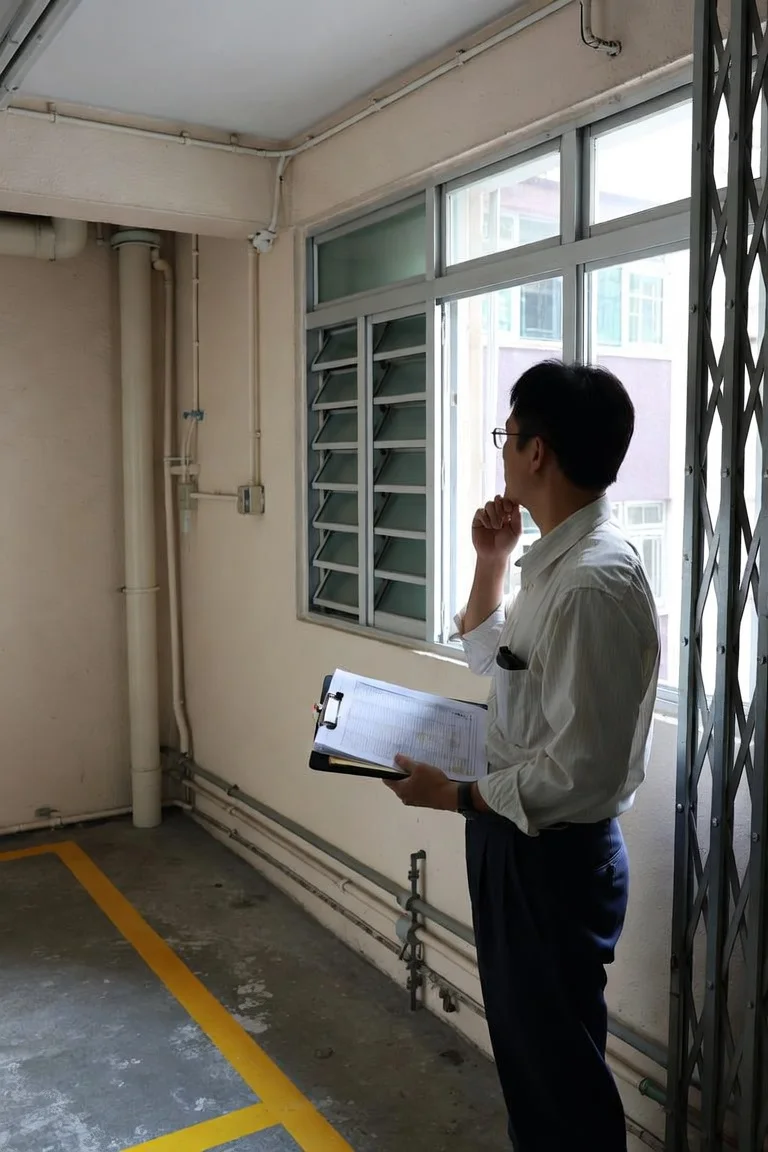
The second step is to arrange on-site inspection of common areas. Inspectors must examine each window’s frame structure, sash opening mechanisms, glass condition, waterproof seals, and fixing screws. Common corridor windows are usually numerous, so it is advisable to allocate a full day for completion.
The third step is to obtain the inspection report and evaluate repair recommendations. The report should clearly list the condition rating of each window, recommended repair items, and priority order. OC committee members should confirm in writing with the inspectors to distinguish necessary repairs (safety hazards) from preventive maintenance. EJW’s consistent position is to recommend only genuinely required repairs, avoiding unnecessary expenses for owners.
The fourth step is to complete repairs and obtain the Certificate of Completion of Repair. After repairs are finished, the Authorized Person must issue the certificate, which the OC uses to submit follow-up to the Buildings Department and formally close the legal requirements of the inspection notice. All documents in the process, including the inspection notice, contracts, reports, and certificates of completion, should be retained for no less than seven years.
The Four Most Common Window Inspection Mistakes Made by Owners’ Corporations
In practice, Owners’ Corporations repeatedly make the same errors when handling common area window inspection. Understanding these mistakes can help avoid unnecessary legal and financial risks.
Error 1: Mistakenly Assuming the Common Area Inspection Notice Only Concerns Private Owners
Some OC committee members, upon receiving a Buildings Department notice, mistakenly believe it is addressed to the building and that responsibility lies solely with individual owners. If the notice clearly pertains to common areas, the OC has an obligation to follow up and cannot simply refer it to individual owners.
Error 2: Appointing Unqualified Window Inspection Personnel
Some extremely low-priced inspection services on the market are performed by personnel without Buildings Department recognition. Their reports will not be accepted by the Buildings Department, requiring the OC to arrange everything again and wasting time and money. EJW recommends that the OC verify the Buildings Department registration numbers of inspection personnel before signing contracts. This information can be checked on the official Buildings Department website’s register of qualified persons.
Error 3: Ignoring the DMC’s Definition of Common Areas
Appointing inspectors without first reviewing the DMC may cause the OC to bear costs for windows that are not common areas, or conversely, to overlook windows that fall within common areas, leading to subsequent disputes.
Error 4: Commencing Repair Works Without Owners’ Meeting Authorization for Costs
If common area repair costs exceed the thresholds stipulated in the Building Management Ordinance, the OC must first obtain authorization by resolution at an owners’ meeting before using management fee reserves or levying special contributions. OCs that bypass this procedure risk complaints or legal action from owners against committee members for irregularities.
Frequently Asked Questions
Can an Owners’ Corporation refuse to handle a common area window inspection notice?
No. Under the Buildings Ordinance (Cap. 123), responsibility for the safety of windows in common areas rests with the Owners’ Corporation. Mandatory window inspection notices issued by the Buildings Department have legal force. If the OC refuses to follow up or fails to complete inspection and repair within the specified period, it may face prosecution by the Buildings Department, and committee members may also face personal legal liability.
Can the OC coordinate window inspection for the entire building, including private units?
Yes, but written authorization from the relevant owners is required. There are advantages to the OC coordinating building-wide inspection: collective tendering usually secures more reasonable service fees, and inspection work can be arranged uniformly, minimizing disturbance to residents. However, the OC cannot sign inspection contracts or bear inspection costs for private units without owner authorization.
How long should common area window inspection reports be retained?
It is recommended to retain them for no less than seven years. Although there is no explicit statutory minimum retention period, considering potential civil litigation limitation periods and possible Buildings Department requests for historical maintenance records, seven years is the generally accepted reasonable period in the industry. Computerized inspection reports should be backed up in PDF format and stored in a secure cloud or physical filing system.
If an individual owner refuses to arrange window inspection for their private unit, is the OC responsible?
The OC has no enforcement power over private unit window inspection; legal responsibility rests with the owner concerned. However, the OC has a duty to forward the Buildings Department’s inspection notice in writing to the relevant owners and keep records. If the OC has fulfilled its notification obligations, it will generally not be held jointly liable for an individual owner’s non-compliance.
If inspectors identify serious safety hazards in common areas, must the OC immediately prohibit use of the affected windows?
Yes. If inspectors confirm in writing that a window poses an immediate risk of falling, the OC should immediately implement temporary safety measures, such as sealing the window with tape, arrange emergency repairs in the shortest possible time, and notify the Buildings Department. Continuing to allow dangerous windows in common areas to be used normally may significantly increase the OC’s legal liability if injury or death occurs subsequently.
References
- Buildings Department Official Website: Mandatory Window Inspection Scheme and Register of Authorized Persons
- Hong Kong e-Legislation: Full text of Buildings Ordinance (Cap. 123) and Building Management Ordinance (Cap. 344)
- Home Affairs Bureau: Owners’ Corporation Responsibilities and Building Management Guidelines
- Hong Kong Institute of Surveyors: Reference Guidelines on Building Inspection and Repair Cost Estimation