Aluminum Window Waterproof Sealant Edge Aging and Detachment: Complete Handling Guide – Detailed Steps for Sealant Edge Replacement
Hong Kong residential aluminum windows’ waterproof sealant edges have an average service life of only five to eight years. Once the sealant edges harden, crack, or detach, rainwater will seep through the gaps in the window frame. In mild cases, this causes wall mold; in severe cases, it affects floor slab structure. Many owners mistakenly believe that applying a layer of silicone sealant can solve the problem, but this only addresses the symptoms rather than the root cause. This article, written from a practical engineering perspective, explains the causes of sealant edge aging, identification criteria, and the correct replacement procedures step by step. It helps owners of private residential buildings and public housing estates in Hong Kong effectively address this high-frequency maintenance issue before and after the mandatory window inspection.
Table of Contents
- Causes and Identification of Sealant Edge Aging
- Quick Key Highlights
- Preparation Before Sealant Edge Replacement
- Complete Steps for Sealant Edge Replacement
- Comparison of Different Types of Sealant Edges
- Common Mistakes and Professional Advice
- Relationship Between Mandatory Window Inspection and Sealant Edge Repair
- Frequently Asked Questions
Quick Key Highlights
| Key Insight | Explanation |
|---|---|
| Sealant edge lifespan shorter than window frame | Aluminum window frames can last over twenty years, but silicone waterproof sealant edges typically harden and detach after five to eight years. They require independent replacement without needing to replace the entire window. |
| Manual tearing is the most common destructive practice | Directly pulling off old sealant edges by hand damages the window groove. The correct method is to cut along the edge with a utility knife and then use a sealant removal tool to extract it. |
| Base cleaning determines new sealant edge lifespan | If residual old adhesive is not completely removed, the adhesion of the new sealant edge drops by more than 50%, rendering the waterproofing effect ineffective. |
| Sealant strip and caulking are two different processes | Rubber sealant strips (edges) are embedded in the window groove, while silicone sealant fills joints. The two cannot replace each other and serve completely different functions. |
| Hong Kong humidity accelerates aging | Hong Kong’s average annual relative humidity reaches 78% to 85%. Combined with UV exposure and high-humidity environment, sealant edge aging is approximately 30% faster than in temperate regions. |
| Mandatory window inspection must check sealant edge condition | Under the Buildings Ordinance (Cap. 123), window inspectors must assess window sealing and waterproofing conditions. Severe sealant edge aging is a repairable defect item. |
| DIY replacement has technical thresholds | Embedded rubber sealant edges require specialized tools and correct size accessories. Incorrect models may cause sealing failure or unstable glass fixing, posing safety risks. |
Causes and Identification of Sealant Edge Aging
Hong Kong’s climatic environment has a greater destructive effect on aluminum window accessories than most owners realize. The high-humidity season lasting nearly half a year each year, combined with direct summer ultraviolet rays, causes the waterproof sealant edges at window frame edges to suffer long-term physical and chemical erosion.
Major Causes of Aging
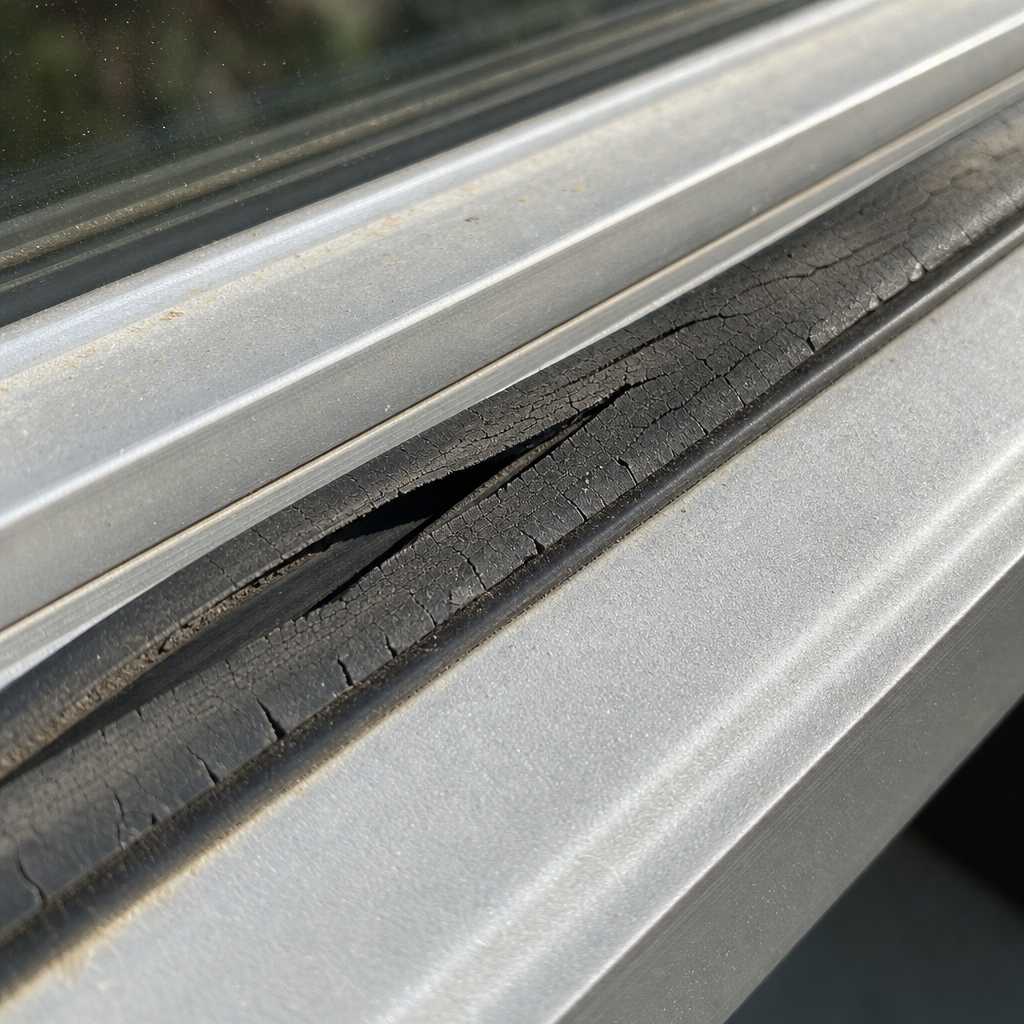
The first is ultraviolet degradation. South- or west-facing windows receive several hours of direct sunlight daily. The molecular chains of silicone and EPDM rubber gradually break under UV exposure, causing the surface to powder first, then harden and crack.
The second is thermal expansion and contraction. In Hong Kong, window frame surface temperatures can exceed 60°C in summer and drop to around 10°C in winter. The drastic temperature differences cause repeated expansion and contraction of the sealant edges, eventually leading to detachment from the groove.
The third is cleaning agent erosion. Many households use alkaline cleaners on windows, which accelerate the material decomposition of rubber sealant edges over time.
The fourth is mechanical wear. Friction between the sealant edge and window frame during repeated opening and closing gradually causes localized thinning or even breakage.
How to Determine Whether Sealant Edges Need Replacement
In practice, there are four clear indicators: (1) Visible cracking – obvious cracks appear on the sealant edge surface; it crumbles when lightly pressed with a finger. (2) Detachment from groove – the sealant edge partially or fully comes out of the window groove and cannot be pressed back to maintain sealing. (3) Hardening and loss of elasticity – normal rubber sealant edges should rebound after pressing; if they remain depressed, they have lost their sealing function. (4) Water seepage signs – water marks appear on the inner windowsill or wall after rain. After ruling out issues with silicone joints, the problem points to sealant edge failure.
Tip: Before every rainy season, run your finger along the window groove edges. If you feel protruding, detached sealant edges or discover powdery debris, arrange replacement immediately. Do not wait until leakage occurs.
Preparation Before Sealant Edge Replacement
Many DIY owners skip preparation steps and start installing new edges immediately after tearing off the old ones. As a result, the new sealant edges detach again within three months. Proper preparation accounts for at least one-third of the total project time.
Tool List
Essential tools include: a utility knife (with new and sharp blades), sealant edge removal tool or flathead screwdriver, adhesive remover (specialized silicone remover or alcohol), cloths or cotton swabs, ruler or tape measure, and new replacement sealant edges. If silicone joints also need filling, prepare silicone sealant and a caulking gun.
Measuring Correct Dimensions is Critical
Aluminum window sealant edge specifications in Hong Kong are not standardized. Embedded rubber strips come in P-type, E-type, D-type, and flat types, each corresponding to different groove depths and opening widths. Measurements must include groove width, groove depth, and exposed sealant edge height. Any dimensional deviation will prevent tight embedding and significantly reduce waterproofing performance.
Practical advice: Remove a short section of the old sealant edge and take it to a hardware store or aluminum window accessory supplier for direct comparison, rather than relying solely on measurements. Even if different brands indicate the same dimensions, cross-sectional shapes may have slight differences.
“Choosing the wrong sealant edge model renders the entire replacement project useless. Aluminum window specifications in Hong Kong’s older buildings vary widely. Some 1970s–1980s window frames use models that are difficult to find on the market and may require custom ordering.” – EJW Technical Team
Complete Steps for Sealant Edge Replacement
The following steps apply to standard embedded rubber sealant edge replacement and are suitable for aluminum windows in private residential buildings over ten years old. Under professional operation, a single window takes approximately 30 to 60 minutes.
Step 1: Remove Old Sealant Edge
Use a utility knife to cut along the joint line between the sealant edge and window frame at a low angle. The goal is to sever the bond between the sealant edge and groove without cutting through the edge itself. Keep the blade close to the groove edge to avoid scratching the oxidized layer on the aluminum frame surface. After cutting, use the sealant removal tool starting from a corner to slowly pry the edge out of the groove.
Step 2: Clean the Groove
After removing the old sealant edge, adhesive residue, dust, and mold spots usually remain in the groove. Use a cloth soaked with silicone remover to wipe the groove repeatedly until the inner walls are completely clean and free of residue. This step requires patience. If residual adhesive exceeds 0.5 mm in thickness, the new sealant edge cannot embed fully. Allow the groove to air dry for at least 15 minutes after cleaning.
Step 3: Cut New Sealant Edge
Measure the length of each side of the window frame. When cutting the sealant edge, reserve approximately 3% to 5% extra length, as rubber edges will contract slightly after embedding. Corner joints can be either 45-degree miter cuts or right-angle overlapping insertion. The former provides a neater appearance, while the latter offers better sealing. Professional work typically uses the latter.
Step 4: Embed New Sealant Edge
Starting from one corner of the window frame, use your thumb to press the embedding portion of the sealant edge into the groove and push it evenly along the entire length. Avoid pulling the edge, as stretched rubber temporarily thins and will spring out of the groove after recovery. At corner positions, use a flat tool to assist pressing the edge tightly into the corner groove, ensuring no gaps.
Step 5: Inspection and Testing
After fully embedding the sealant edge, press along the entire length with your fingers to confirm that every section is properly seated in the groove with no protrusions or detachment. To test waterproofing, use a showerhead or hose to spray water at medium pressure from about 30 cm away for three minutes, then check indoors for any water marks on the windowsill and around the frame.
Tip: After installing the new sealant edge, apply a thin layer of silicone oil to the exposed surface. This can extend the service life by two to three years and prevent dust accumulation that accelerates aging.
Comparison of Different Types of Sealant Edges
The main sealing materials used for aluminum window repairs in Hong Kong fall into three major categories, each with suitable applications and limitations. Choosing the wrong material not only affects performance but also directly impacts post-repair service life.
| Type | Application Scenarios | Advantages and Limitations |
|---|---|---|
| EPDM Rubber Embedded Sealant Edge | Window frame groove sealing and glass fixing sealing | Excellent weather resistance, UV and ozone resistance, with a service life of 10 to 15 years. Requires correct sizing and has certain technical installation requirements. |
| Silicone Sealant (Glass Sealant) | Joints between window frame and wall, or glass and frame | Flexible application for irregular gaps. Not embedded type; prone to tearing under long-term stress, with a service life of about five to eight years. Cannot replace rubber sealant edges. |
| PVC Foam Sealant Strip | Sealing between window sash and frame (mainly for sound insulation) | Easy installation and low cost. Waterproof performance is far inferior to EPDM edges. Easily deforms and loses elasticity under high temperatures. Not recommended for primary waterproof positions. |
Common Mistakes and Professional Advice
From on-site construction experience, the most common mistakes made by owners performing DIY sealant edge replacement are not due to lack of skill, but underestimating the detailed requirements of each step.
Mistake 1: Installing New Sealant Edge Directly Over Old One
This is the most common error. The old sealant edge has already lost elasticity. Adding a new one not only fails to improve sealing but also causes overfilling of the groove, preventing normal window closure and even exerting extra pressure on the glass. The correct approach is to completely remove the old edge before installing the new one.
Mistake 2: Ignoring Corner Sealing
The four corner positions of the sealant edge are the most common leakage points. In many installations, the corner sections are not pressed tightly, leaving tiny gaps. During typhoons, rainwater under strong wind pressure can seep through gaps as small as 0.3 mm.
Mistake 3: Performing Pressure Testing Immediately After Installation
Some sealant edges that use auxiliary adhesive require at least 24 hours for curing. Conducting high-pressure water testing immediately after installation may dislodge the not-yet-fixed edges, requiring reinstallation.
If the project involves high-floor external windows or systemic leakage affecting the entire building, it is recommended to engage a licensed aluminum window engineering company. The Buildings Department requires technical personnel involved in mandatory window inspection to possess relevant qualifications. The engineering team of EJW is led by personnel recognized by the Building Authority, ensuring works comply with the technical requirements of the Buildings Ordinance (Cap. 123).
Relationship Between Mandatory Window Inspection and Sealant Edge Repair
Under Hong Kong’s Buildings Ordinance (Cap. 123), private buildings over ten years old must undergo periodic mandatory window inspection. The scope covers structural safety and waterproof sealing of windows. Aging and detachment of sealant edges are classified as repairable defects.
Common Sealant Edge Issues in Inspection Reports
In actual inspection cases handled by EJW, approximately 60% of residential units over 15 years old have varying degrees of aluminum window sealant edge aging. The most common is partial detachment from groove (about 40% of cases), followed by severe surface cracking (about 30%), and complete detachment (about 20%).
Importantly, inspection reports only list items that genuinely require repair. Responsible inspection companies should not exaggerate problems or recommend unnecessary replacements. EJW’s inspection principle is to propose repairs only for defects that pose real safety or waterproofing risks, avoiding unnecessary costs for owners.
After receiving a window inspection notice, owners are advised to check the sealant edge condition of all windows beforehand. Addressing obvious aging problems in advance can reduce pressure from urgent repairs required within a time limit after inspection.
Frequently Asked Questions
How often should aluminum window waterproof sealant edges be replaced?
Under Hong Kong’s climatic conditions, it is recommended to inspect sealant edges every five to eight years. Replace immediately upon signs of cracking, hardening, or detachment. Do not wait until complete failure. South- or west-facing windows age faster due to stronger sunlight and should be inspected every four to six years.
Can I replace aluminum window sealant edges myself?
For low floors (below the third floor) where windows can be operated from indoors, owners with basic DIY skills can perform the replacement. However, correct size and model of sealant edges must be used, and groove cleaning and proper embedding steps must be strictly followed. For high floors, outward-opening windows, or sealant edges involving glass fixing positions, a licensed engineering company must be engaged to avoid safety risks in high-altitude operations.
What is the difference between sealant edge detachment and silicone joint cracking?
Embedded rubber sealant edges are located inside the window groove and function to fix glass and seal structural gaps in the window frame. Silicone sealant (glass sealant) is the visible filler applied between glass and frame. These are separate processes and must be handled individually. Cracking of silicone joints does not mean the sealant edge is damaged, and vice versa. They must be assessed separately.
How much does sealant edge replacement cost?
In the Hong Kong market, replacing embedded rubber sealant edges on a single aluminum window, including labor and materials, costs approximately HKD 300 to 800, depending on window size and edge model. Additional costs apply if silicone joints also need replacement. Some companies offer bulk discounts for whole floors or buildings.
How soon after replacement can waterproof testing be performed?
Embedded rubber sealant edges can undergo pressure testing on the same day if no additional adhesive is used. If silicone sealant is used to fix corners, wait at least 24 to 48 hours for full curing before formal waterproof testing.
If sealant edge problems are found during mandatory inspection, must the original inspection company perform the repairs?
No. Owners may choose any licensed aluminum window engineering company for repairs. However, after completion, a qualified person must verify that the works meet inspection requirements and issue a report to complete the statutory repair procedure. When selecting a repair company, confirm it has the relevant qualifications and can provide written engineering reports.
References
- Hong Kong Buildings Department Official Website: Mandatory Window Inspection Scheme and Buildings Ordinance Provisions
- Hong Kong Civil Engineering and Development Department: Technical Guidelines on Weathering Resistance of Building Materials
- ASTM International: Rubber Sealing Materials and Window Waterproofing Test Standards
- International Organization for Standardization (ISO): Performance Specifications for Building Sealants and Jointing Materials
- Hong Kong Housing Authority: Public Housing Window Maintenance Guidelines