A damaged aluminum window handle may seem like a minor issue, but it directly affects home safety and daily usage. Many Hong Kong property owners facing aluminum window handle replacement are often unclear about the differences between seven-shaped switch handles and traditional switch handles, and they do not know the reasonable charges. Market quotes vary greatly—some technicians charge hundreds of dollars for the handle alone, while others offer the full service (labor and parts) for only HK$100. Property owners have no way to judge. This article, written from a professional window engineering perspective, dissects the characteristics, applicable scenarios, replacement costs, and common purchasing mistakes of the two main handle types, enabling you to be well-prepared before engaging window repair services.
Table of Contents
- Key Highlights
- Structural Differences Between Seven-Shaped Handles and Traditional Handles
- Detailed Explanation of Aluminum Window Handle Replacement Costs
- Situations Where Handle Replacement Is Mandatory
- Common Mistakes When Purchasing Aluminum Window Accessories
- Comparison Table: Seven-Shaped Handle, Traditional Handle, and Crank Handle
- Relationship Between Mandatory Window Inspection Scheme and Handle Condition
- Frequently Asked Questions
Key Highlights
| Key Insights | Description |
|---|---|
| Seven-shaped handles and traditional handles have different structures | Seven-shaped switch handles adopt a rotary locking mechanism, while traditional handles use latches or catches for fixation. The two types are not interchangeable. |
| Replacement costs vary by model | Individual handle parts in the market cost approximately HK$30 to HK$120. Full labor and parts service generally ranges from HK$100 to HK$300. |
| Material directly affects durability | Zinc alloy handles are 3 to 5 times more durable than plastic versions. In the long run, they result in lower overall replacement costs. |
| Damaged handles may affect inspection results | Under the Mandatory Window Inspection Scheme, handle failure is regarded as a window safety defect and will be listed in repair recommendations. |
| Not all handles need immediate replacement | Minor looseness can first be resolved by tightening screws. Only severe damage or inability to open/close normally requires full replacement. |
| Older public housing commonly uses traditional handles | Aluminum windows in 1980s–1990s Home Ownership Scheme and public rental housing mostly adopt traditional latch-style handles, and some parts are already discontinued. |
| EJW charges only for necessary repairs | After inspection by registered personnel, only confirmed necessary parts will be charged, avoiding unnecessary expenses. |
Structural Differences Between Seven-Shaped Handles and Traditional Handles
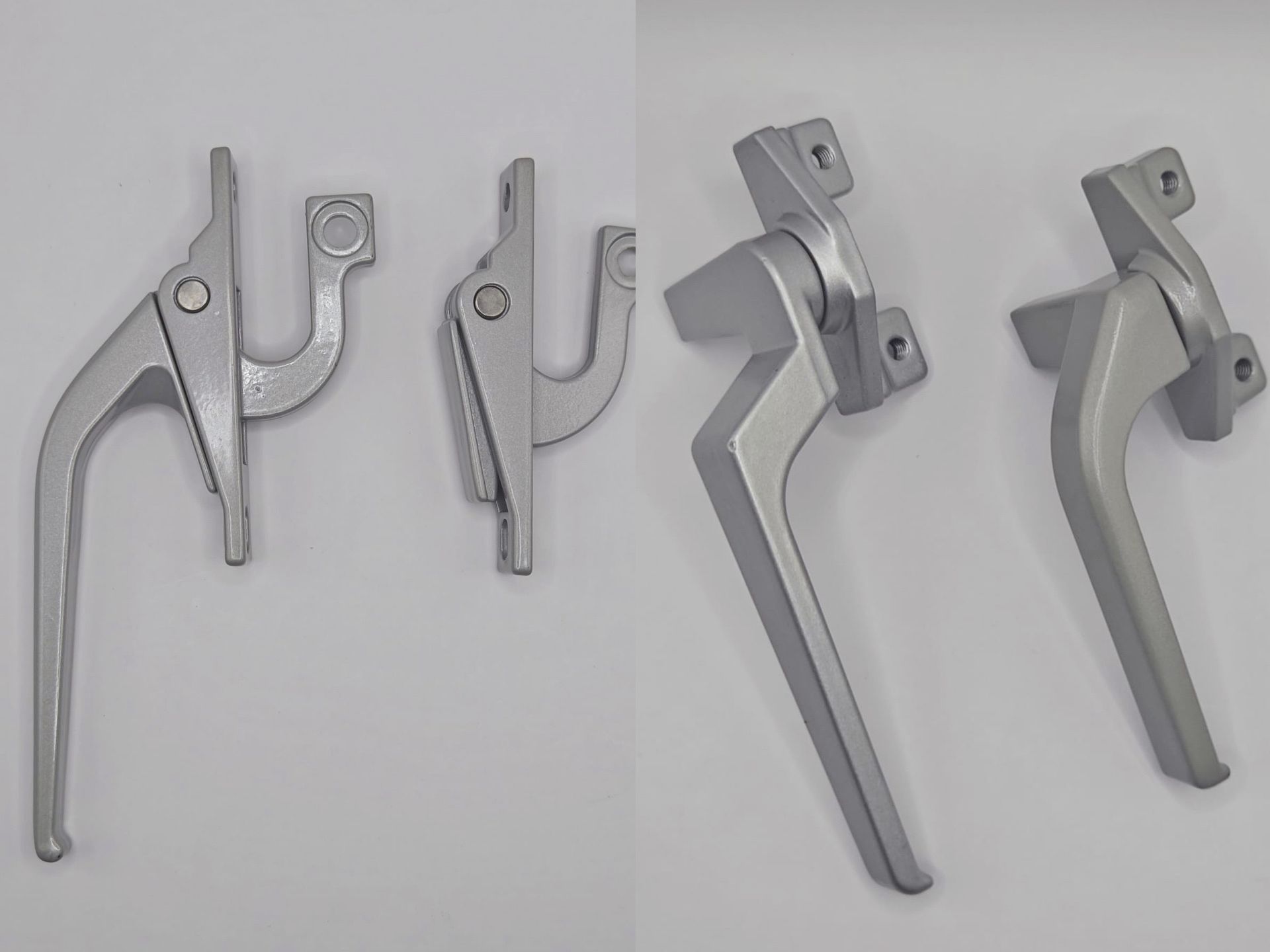
In the Hong Kong residential aluminum window market, seven-shaped switch handles and traditional switch handles are the two most common types. Visually, the operating lever of a seven-shaped handle forms a “7” shape; pushing it downward locks the window sash. Traditional handles are more square or curved in appearance and secure the sash position via latches or catches. The two types differ significantly in opening method, locking principle, and mounting hole spacing, and cannot be directly interchanged.
The seven-shaped handle design became popular in the late 1990s. Most newly completed private residential aluminum windows in Hong Kong now adopt this type. Its advantage is that opening and closing can be completed with one hand. The operation is intuitive and particularly convenient for the elderly and children. Traditional handles are more commonly found in older Home Ownership Scheme flats, public rental housing, and early private buildings. The design requires pulling the latch first before pushing the window, involving more steps.
In actual repair work, a common mistake made by property owners is purchasing “universal” handles from hardware stores themselves. After installation, they often discover that the hole spacing does not match or the rotation direction is reversed. This not only renders the handle unusable but may also prevent the window sash from locking completely, creating safety risks.
Structural Features of Seven-Shaped Handles
The core component of a seven-shaped handle is an eccentric rotating shaft. When the handle is pushed downward, the shaft drives a locking block into the fixed seat on the window frame, producing a locking effect. This design offers uniform locking force and is less susceptible to the impact of minor sash deformation on closing performance. Common specifications include handle lever lengths of 70 mm and 90 mm, with mounting hole spacings of 35 mm and 45 mm. Accurate measurements must be taken before purchase.
Seven-shaped handles are mainly made of zinc alloy, aluminum alloy, and ABS engineering plastic. Zinc alloy versions feel solid and are highly resistant to rust, recognized as the most durable choice. ABS plastic versions are lower in price but tend to age and become brittle within approximately 3 to 5 years in Hong Kong’s humid environment.
Structural Features of Traditional Handles
Traditional switch handles come in various designs, commonly including T-shaped latch, round rotary, and hook-shaped catch types. Early public housing aluminum windows in Hong Kong mostly used hook-shaped catch designs. When the sash closes, the handle drives the hook-shaped catch to engage the fixed pin. The structure is simple but wears out relatively quickly.
Since some traditional handle models have ceased production, property owners often face difficulties when sourcing replacement parts. In such cases, there are two options: engage a window engineering company familiar with older accessories to source compatible parts, or replace the entire system with a new seven-shaped handle setup. The latter requires simultaneous replacement of the handle base and fixed seat, resulting in relatively higher costs.
Detailed Explanation of Aluminum Window Handle Replacement Costs
Hong Kong aluminum window handle replacement costs are determined by part quality, installation difficulty, and the technician’s pricing method. According to actual market conditions, the cost of a single seven-shaped handle part is approximately HK$30 to HK$120, while the full labor-and-parts replacement quote usually ranges from HK$100 to HK$300. Due to the relative scarcity of traditional latch-style handles, costs may be higher if special ordering or compatible parts are required.
It is worth noting that price differences often do not stem entirely from handle quality itself, but from the construction approach. For straightforward damage, such as a broken rotating shaft or stripped screws, qualified engineering personnel can usually complete the replacement within 30 minutes. However, if the window sash itself has deformed due to prolonged use and the handle still cannot lock properly after replacement, window frame issues must also be addressed, naturally increasing the cost.
Some contractors attract property owners with low-priced handles but actually use low-quality, cheap plastic versions from mainland China, which require replacement again within six months to a year. EJW’s practice is to clearly specify the part specifications and sources after inspection, allowing property owners to know exactly what they are paying for, rather than using vague quotes to obscure part costs.
Main Factors Affecting Costs
The first factor is handle material. Zinc alloy handles cost approximately HK$60 to HK$120 each in the market, while ABS engineering plastic versions cost HK$35 to HK$60. Although choosing zinc alloy involves roughly double the initial cost, its service life can reach 8 to 10 years under Hong Kong’s sea breeze and humidity conditions, far exceeding the 3 to 5 years of plastic versions.
The second factor is the building floor level. For high-rise units or those with special window designs, technicians need to use safety ropes or special tools. The construction difficulty is higher, and labor costs are usually HK$50 to HK$100 more than for standard low-rise units.
The third factor is the number of handles replaced. When multiple handles need to be replaced simultaneously, the average cost per unit will decrease due to batch construction. EJW recommends that property owners assess the condition of all window handles during mandatory window inspections and handle necessary replacements together, which can save labor costs from multiple site visits.
Situations Where Handle Replacement Is Mandatory
Not all handle problems require immediate full replacement of the part. In actual operations, approximately 30% of “failed” handle cases can actually be restored to normal function simply by retightening fixing screws or cleaning jammed rotating shafts. However, in the following situations, aluminum window handle replacement must be carried out without delay.
The first situation is complete breakage of the handle’s rotating shaft. In this case, the window sash cannot be locked, and it may be blown open during typhoons or strong winds, posing a safety hazard. Every typhoon season in Hong Kong, incidents of window sashes opening unexpectedly due to handle failure occur.
The second situation is when the handle’s looseness exceeds the normal range, and it still wobbles even after retightening the screws. This usually means the mounting holes on the handle base have worn and enlarged, or the aluminum window frame itself has slight deformation. In such cases, the entire handle assembly must be replaced.
The third situation is severe oxidation or corrosion on the handle surface, causing sluggish or jammed rotation. Forcibly twisting a corroded handle may cause the rotating shaft to break, increasing repair difficulty and cost. When obvious signs of rust appear on the handle, it should be replaced as soon as possible rather than waiting until it is completely jammed.
“Damage to window accessories is often gradual. When property owners feel slight resistance or looseness during daily operation, they should arrange for professional inspection as early as possible rather than waiting until the handle is completely unusable before taking action.” — Common advice in the Hong Kong aluminum window engineering industry.
Common Mistakes When Purchasing Aluminum Window Accessories
When Hong Kong property owners purchase aluminum window accessories themselves, the most common mistake is relying on appearance to judge compatibility. Seven-shaped handles on the market look largely similar, but differences in hole spacing specifications can reach more than 10 mm. If the hole positions do not match after installation, minor cases may require redrilling, while severe cases can compromise the structural integrity of the window frame.
The second common mistake is ignoring the handle’s rotation direction. Seven-shaped handles are available in “left-opening” and “right-opening” versions, corresponding to the sash opening direction. Purchasing the opposite direction results in operation that is reversed compared to other windows, causing long-term confusion, especially for elderly family members.
The third mistake is excessively pursuing low-priced parts. In hardware stores in Mong Kok or Sham Shui Po, handles can indeed be found for as low as HK$20 to HK$30 each. However, these products mostly use recycled zinc alloy or low-grade ABS plastic. In Hong Kong’s humid coastal environment, they often corrode or become brittle in less than a year. From a total cost perspective, the long-term expense of using inferior parts is often higher than choosing quality handles from the beginning.
Tip: Before replacing a handle, first use a vernier caliper to measure the original handle’s mounting hole spacing and rotating shaft diameter. Record the data before procurement to avoid wasting time and money due to specification mismatches.
Comparison Table: Seven-Shaped Handle, Traditional Handle, and Crank Handle
In the Hong Kong market, in addition to seven-shaped handles and traditional latch-style handles, some newer floor-to-ceiling windows or large sliding windows also use crank handle designs. The following comparison table summarizes the main differences among the three handle types in actual use for property owners’ reference.
| Comparison Item | Seven-Shaped Switch Handle | Traditional Latch Handle | Crank Handle (执手) |
|---|---|---|---|
| Operation Method | Downward rotation to lock | Insert fixed pin to lock | Rotation or push-pull operation |
| Common Applications | Private residential outward-opening windows | Older public rental housing and Home Ownership Scheme flats | Large floor-to-ceiling windows and sliding windows |
| Parts Market Supply | Abundant, with many brands and specifications | Some models discontinued | Abundant, mainly imported brands |
| Parts Price Range | HK$35 to HK$120 | HK$30 to HK$100 (depending on model) | HK$80 to HK$300 |
| Full Labor Replacement Cost | HK$100 to HK$300 | HK$100 to HK$300 | HK$250 to HK$600 |
| Average Service Life | Zinc alloy version: 8 to 10 years | 5 to 8 years | 10 to 15 years |
| DIY Installation Difficulty | Medium | Medium to difficult | Difficult — professional installation recommended |
From the comparison data, it is clear that crank handle types have the highest initial cost but the longest service life, making them suitable for large windows. Seven-shaped handles currently offer the best balance of cost-effectiveness, while traditional latch-style handles have lower long-term maintenance flexibility due to parts supply issues.
Tip: If your residential property is an older public rental housing or Home Ownership Scheme flat built before the 1990s, it is recommended to consult during the window inspection whether it is necessary to upgrade the traditional handle system to seven-shaped handles to ensure long-term stability of parts supply.
Relationship Between Mandatory Window Inspection Scheme and Handle Condition
According to Chapter 123 of the Buildings Ordinance in Hong Kong, residential and commercial buildings aged 10 years or above must arrange regular window safety inspections under the Buildings Department’s Mandatory Window Inspection Scheme. Many property owners mistakenly believe that window inspections only examine whether the window frames and glass are intact. In reality, the functional condition of handles is an important component in assessing window safety.
In EJW’s professional window inspection process, every window undergoes handle operation testing, including checks on the handle’s locking effectiveness, the stability of the rotating shaft, and the connection condition between the handle base and the window frame. If the handle cannot effectively lock the window sash, even if the window frame structure itself is intact, the inspection report will list it as a required repair item.
This has real financial implications for property owners. If damaged handles are proactively replaced before the inspection, the pass rate during inspection will naturally be higher, avoiding the risk of being required by the Buildings Department to complete repairs within a deadline due to failure, which may lead to accepting higher quotes under time pressure. EJW provides computerized inspection reports issued by Buildings Department-registered personnel, clearly detailing the condition of each window and recommended repair items, so property owners can clearly understand which repairs are necessary and which can be temporarily observed.
The Hong Kong Buildings Department’s Mandatory Window Inspection Scheme operates on a 10-year cycle. Property owners should make full use of the inspection opportunity to comprehensively assess the condition of window accessories, rather than handling them individually only after complete handle failure. Overall planning of window maintenance will, in the long run, save more costs than passive part replacements.
For more details about the Mandatory Window Inspection Scheme or to arrange a professional window inspection by Buildings Department-registered personnel, please refer to the official EJW website at EJW’s official website for service details.
Frequently Asked Questions
Can seven-shaped handles and traditional handles be interchanged?
They cannot be directly interchanged. The mounting hole spacing, rotating shaft specifications, and locking mechanisms of the two types of handles are all different. If converting from a traditional handle to a seven-shaped handle, both the handle base and the fixed seat on the window frame must be replaced simultaneously. This constitutes a larger-scale accessory upgrade project and should be assessed by professional window engineering personnel before deciding whether to proceed.
What is the approximate cost of aluminum window handle replacement?
The full labor-and-parts cost for replacing a seven-shaped handle in the market generally ranges from HK$100 to HK$300, depending on the handle material and installation difficulty. Zinc alloy handles are more expensive than ABS plastic versions but offer significantly better durability. When replacing multiple handles simultaneously, the average cost per unit is usually reduced. It is recommended to ask the contractor to clearly specify the material and brand of the parts used to avoid using low-priced parts as substitutes.
Does a loose handle necessarily need to be replaced?
Not necessarily. Minor looseness can first be addressed by attempting to retighten the fixing screws. If the problem is resolved, replacement is not required. However, if the handle still wobbles after tightening the screws, or if the rotating shaft shows obvious wear, the entire handle must be replaced. Do not overlook persistent looseness, as prolonged use in a loose state will accelerate wear and eventually lead to complete failure, at which point replacement difficulty and cost will be higher.
Will damaged handles affect the result of a mandatory window inspection?
Yes. The functional condition of handles is part of the window safety assessment. If the handle cannot effectively lock the window sash, the inspection report will list it as a repair recommendation item. Property owners who proactively inspect and replace damaged handles before the inspection can improve the inspection pass rate, avoiding unnecessary costs from being forced into emergency repairs within a deadline due to failure.
How to determine whether a seven-shaped handle or traditional handle needs to be replaced?
The most direct method is to observe the handle’s operation method. If the existing handle requires downward rotation to lock, it is a seven-shaped handle. If it uses a latch or hook mechanism for fixation, it is a traditional handle. If unsure, take photos before replacement and consult professional window engineering personnel to confirm the correct model before procuring parts, avoiding wasted costs from purchasing the wrong model.
Is it feasible to replace aluminum window handles oneself?
For property owners with basic DIY skills, replacing a seven-shaped handle is technically feasible, provided the part specifications are confirmed to match exactly. However, if residing in a high-rise building or if the window position requires leaning out to operate, it is strongly recommended to engage professional engineering personnel equipped with safety ropes. One should not take the risk of replacing it oneself, as the safety risks far outweigh the savings on labor costs.
References
- Hong Kong Buildings Department Official Website: Mandatory Window Inspection Scheme and related provisions of the Buildings Ordinance
- Hong Kong Electrical and Mechanical Services Department: Building Services Safety Standards and Maintenance Guidelines
- Hong Kong Consumer Council: Recommendations on Home Repair Service Charges and Contractor Selection
- Hong Kong Housing Authority: Public Housing Construction Standards and Window Accessory Maintenance Policy